
About the Kvemo Kartli Region
Kvemo Kartli is one of the most important historical and geographical regions of Georgia. The modern region includes the historical and geographical provinces of Kvemo Kartli and Trialeti.
The area of the region is 6528 sq. km, which is 10% of the total area of Georgia. From the west, Kvemo Kartli is bordered by the Javakheti Range, the Samtskhe-Javakheti region. To the north, Shida Kartli and Mtskheta-Mtianeti, and to the south, Armenia and Azerbaijan.
The administrative center of Kvemo Kartli is the city of Rustavi.
According to the modern territorial and administrative division, six municipalities are united in the Kvemo Kartli region. These are: the municipalities of Tsalka, Tetritskaro, Dmanisi, Bolnisi, Marneuli and Gardabani.
The Kvemo Kartli region presents all the main stages and cultures of human history. Starting with the paleoanthropological and paleontological archaeological site of Dmanisi, one of the oldest hominin sites in the world, dating back to 1.7-1.8 million years ago and the oldest on the European and Asian continents.
In the 7th-6th millennia BC, in the South Caucasus, including the territory of present-day Kvemo Kartli, one of the earliest early agricultural cultures in the world, known in scientific literature as the “Shulaver-Shomutefe culture”, spread. The construction architecture of the Alizi circular-domed residential and agricultural complexes is widespread in the hill settlements dating from this period. Meanwhile, the main areas of employment of the inhabitants living here were agriculture and cattle breeding. Auxiliary branches of agriculture were gathering; hunting; cooking and making ceramic utensils for agricultural purposes – pottery; leather and flax processing, etc.
At one of the settlements of this period, near the village of Imir in the Marneuli municipality, on the so-called Imir’s cut hill, the remains of the earliest fermented wine in the world, which is laboratory-confirmed to date, have been discovered, which demonstrates the Georgian winemaking tradition with an eight-thousand-year history.
At the dawn of early metallurgy, from the 4th millennium BC, the “Mtkvar-Araxes culture” spread across the territory of Kvemo Kartli. This highly developed metallurgical culture is at the same time one of the earliest metallurgical cultures and the area of settlement of metalworking people. In this period, along with agricultural and personal metal objects, hunting and combat weapons made of metal appear.
This magnificent culture and the corresponding period are associated with the ancient gold mining mine confirmed in Sakdriskedi in the Bolnisi municipality and the nearby, presumably related “miners'” settlement in the area of ”Dzedzebi”, near the village of Balichi.
In the 3rd-2nd millennium BC, the Korgan culture spread in Kvemo Kartli, as well as in the rest of eastern Georgia (Martkop-Alazani group, Bedeni culture, Trialeti culture). Of the kurgans studied in the territory of Dmanisi municipality of this period, the village of Irganchai group of tumuli.
From the second half of the 2nd millennium BC, the Late Bronze Age culture has been widespread in the territory of Eastern Georgia. The topography of the settlements of this period is characterized by the use of naturally, more or less protected, difficult-to-reach places (river mouths – ravines, elevations near ravines, mountain hills, etc.) for housing. At the same time, in addition to the construction of settlements in difficult-to-reach places, they are also surrounded by a fortification – defensive fence. The defensive fences are built of large stone blocks, in a dry, so-called Cyclopean arrangement. Like the settlements, this need for a three-tiered arrangement is an indication of military confrontations and frequent hostilities between the tribes and tribal associations that inhabited the area during this period. Also, a large number of bronze and iron weapons have been confirmed in the Late Bronze-Adrierkin Age burial material.
In the Dmanisi region, among the monuments of the above period, the most notable are the Grhmakhevistavi burial site studied near the Mashavera Gorge; the extensive settlement on a raised cape in the Dmanisi district center, at the confluence of the Mashavera and Yakublo rivers; the settlement confirmed on the hill of Musi Mountain near the village of Kariani; and also, at the Dmanisi archaeological site, the archaeological layers of the Late Bronze-Adrierkin Age confirmed under the layers of the medieval Dmanisi settlement, which represent the given territory as a fairly fortified and large settlement for that time. According to archaeological studies, this settlement dates back to the 9th-7th centuries BC.
In Kvemo Kartli, important archaeological monuments have also been discovered, the dates of which are related to the pre-Christian era, the ancient and Hellenistic periods.
Over the centuries, the borders of Kvemo Kartli have changed, however, it can be said that this area mainly included the basins of the rivers Algeti, Mashavera, Ktsia-Khrami and Debeda.
After the formation of the Kingdom of Kartli, or Iberia (IV-III centuries BC), Kvemo Kartli, which was part of it, had a different name.
It was referred to as: according to Greek-Armenian historical sources, as “Gogarena”, “Gugarch”, and according to Georgian chronicles, as “Kartli Sapitiakhsho”. According to the old Georgian territorial-administrative division, Kvemo Kartli coincided with the territory of the Samshvildi Saeristao. In the 15th century, after the collapse of the united Georgian kingdom, the feudal seigniory formed in this area, Sabaratiano, became one of the banners, military-administrative units of the Kartli kingdom.
At the end of the ancient era and from the 4th century AD, the Christian religion spread in Kvemo Kartli, thanks to the strong geopolitical influence of the Iberian rulers and missionary impulses coming from the central or eastern provinces of the Roman Empire. From then on until the recent period, Georgian Christian culture developed in a diverse way.
Kvemo Kartli is particularly rich in monuments of the early Christian period: churches-monasteries, stelae-crosses of chapel or memorial purpose, epigraphic samples.
The three-nave Basilica of Sioni in Bolnisi is one of the oldest and largest Christian churches of this type in Georgia; near the city of Dmanisi, the remains of the oldest rotunda-type, circular-domed church in Georgia have been discovered, dating back to the 5th century; also, the earliest of the Christian cave monasteries currently known in Georgia is the complex of the Muguti Hidden Church in the Khrami River Gorge, where signs of secret Christian worship have been confirmed.
The socio-economic upsurge and cultural development process in this area reached its culmination in the High Middle Ages (11th-13th centuries). The involvement of Kvemo Kartli in the South Caucasian regional and international foreign trade relations led to the development of trade-caravan routes and the construction of road infrastructure related to the routes – bridges, nut-caravans, etc.
The trade routes passing through Kvemo Kartli connected the countries of the South and North, East and West. The cities of Samshvilde and Dmanisi, located near the mentioned roads, experienced a special boom: they developed into large centers of trade-crafts and commodity production, settlements with multi-ethnic, different religious-confessional groups. Metallurgy-blacksmithing, the production of ceramics, glass, bone products, carpet weaving, leather processing, processing of agricultural crops, etc.
In Kvemo Kartli, there are also numerous monuments of Christian culture from the 11th-13th centuries, when the Georgian state was at the zenith of its development: it is enough to recall the exquisite church buildings of the monastery ensembles of Pitareti, Tsugrughasheni, Gudarekhi, Pirghebuli, and Satkhi.
Dmanisi – About the region

Dmanisi Region
The Dmanisi region is located in the southwest of Kvemo Kartli, Georgia. The territory of today’s Dmanisi Municipality largely follows its ancient historical and geographical boundaries, covering the “Dmaniskhevi” (Dmanisi valley) area — the upper valley of the Mashavera River — as well as the Zurtaketi basin (the Shavtskala/Karaboulakhi River) and the Ktsia-Khrami upper valley.
Dmanisi shares its borders with Tsalka and Tetritskaro to the north, Bolnisi to the east, Ninotsminda to the west, and the Republic of Armenia to the south. The municipality stretches over 1,198.8 km² and brings together the administrative center, the town of Dmanisi, along with 59 villages. Around 20,000 people live here today.
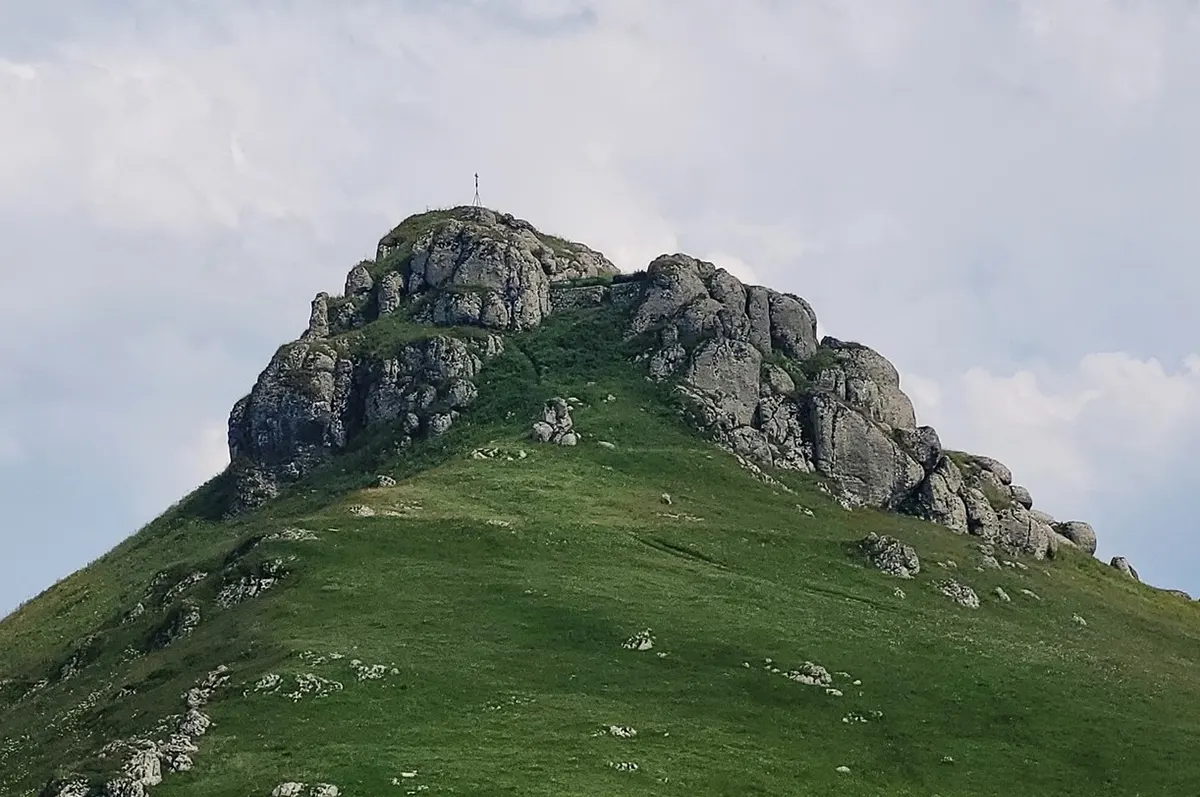
Dmanisi’s diverse natural landscapes combine dense forested mountains and valleys, lava plateaus of mountain steppe, river canyons, and picturesque subalpine and alpine meadows, forming a microregion with exceptionally rich flora and fauna.
Historical Past of Dmanisi
The Dmanisi region is a living chronicle reflecting the rich historical past of humankind. Once one of Georgia’s most prominent areas, it stands at the crossroads of civilizations, where the echoes of history survive through a distinctive local material and spiritual cultural heritage. The traces of ancient settlements, fortresses, and caravan routes all point to Dmanisi’s remarkable geographical position and strategic importance. Every major stage of human history and culture is represented here: from the site of some of the world’s oldest hominin discoveries, to the populations that practiced early agriculture and metallurgy; from the Grand Kurgan culture of the Bronze Age, to the flourishing medieval towns and masterpieces of Christian architecture.
From the 4th century AD onward, thanks to the firm pro-Western geopolitical orientation of Georgian rulers, Christianity spread throughout Kvemo Kartli, including Dmanisi. From that time until the modern era, Georgian Christian culture developed here in diverse forms, clearly expressed in the many architectural monuments, cultural heritage sites, and other treasures of material culture that enrich the region today.
The Medieval City of Dmanisi
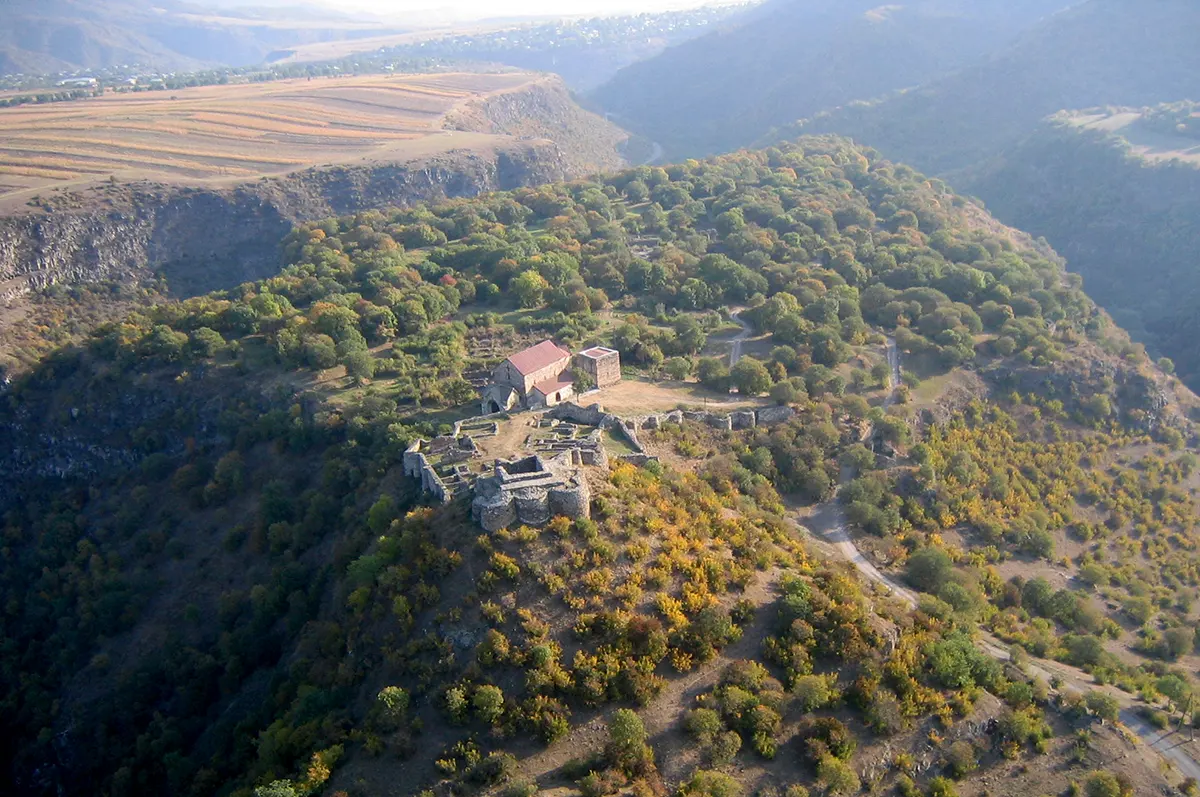
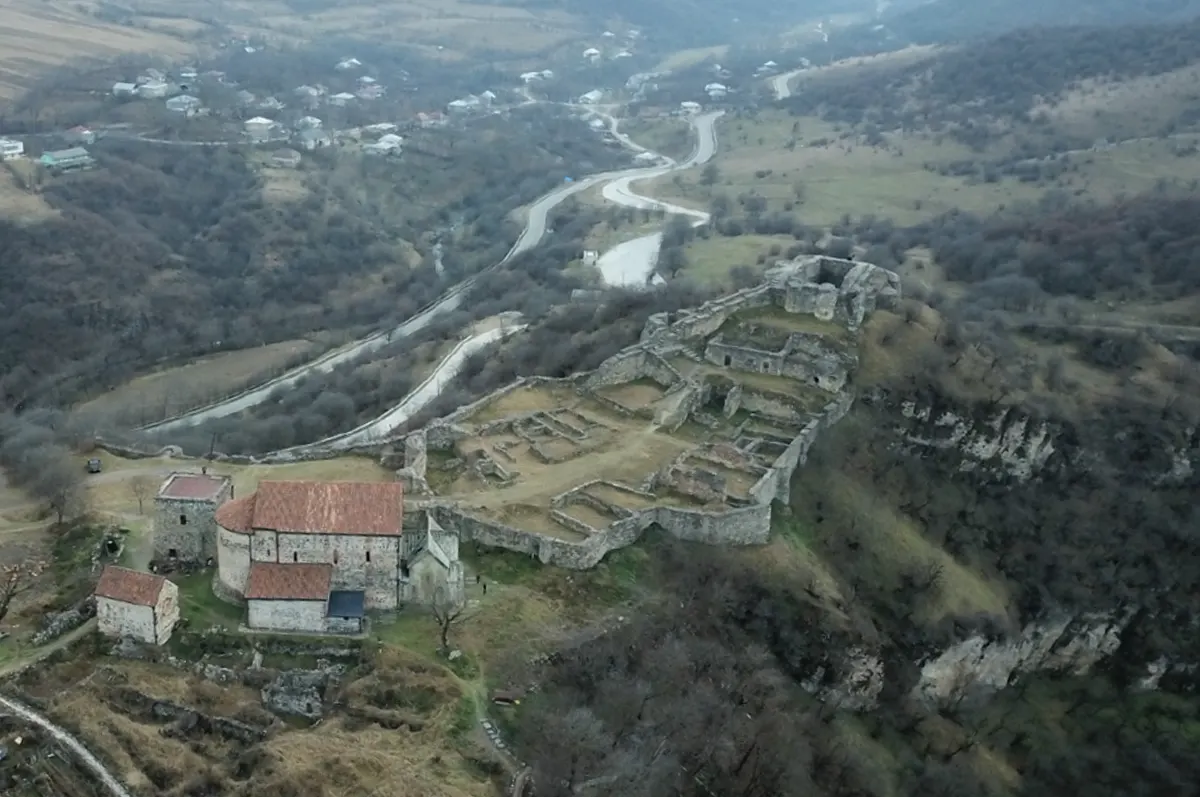
The medieval site of Dmanisi is a multi-layered archaeological monument that preserves traces of many eras. On the site of a Stone Age settlement, a Late Bronze-Early Iron Age village, and a Late Antique habitation, a fortress-city was established in the 9th century, from which Dmanisi became the territorial-administrative center of the upper Mashavera Valley. During its first urban stage, in the 9th–11th centuries, the city passed through the hands of different rulers. In 1123, it was liberated by King David IV the Builder (1089– 1125) and became a royal city of the Georgian kings. The second stage of urban development, in the 12th–14th centuries, was Dmanisi’s golden age. Trade flourished, crafts expanded — from ceramics, glass, and bone products to metallurgy — and in 1245 copper coins were minted here. New residential quarters, bridges, baths, and caravanserais were built. Favorable trade and economic conditions shaped migration processes, the city’s diverse population, and its urban appearance, with Georgian, Armenian, and Arab neighborhoods and religious buildings emerging side by side.
Thanks to its strategic location at the crossroads of major trade routes, Dmanisi was directly involved in key historical processes unfolding both in the region and in the wider world. At the end of the 14th century, the city was devastated by the invasions of Timur (Tamerlane). From the 15th century onward, the noble Baratashvili, Orbeliani, and Kaplanishvili families, rulers of Kvemo Kartli, rebuilt the fortress, which continued to function until the end of the 18th century.
“The First Europeans” — The Dmanisi Hominins
In the 1980s, beneath the medieval archaeological layers of the medieval city of Dmanisi, fossils of Early Stone Age animals and stone tools were uncovered. In 1991, the first human remain — a lower jaw — was found. The discoveries at Dmanisi make up one of the richest and most complete paleoanthropological collections in the world. To date, five hominin skulls, four lower jaws, and numerous skeletal fragments have been unearthed. Dmanisi is a site of global importance not only for its hominins and artifacts, but also for the abundance of fossilized remains of prehistoric animal species, many of them long extinct. Dated to 1.8 million years ago, the Dmanisi hominins are the oldest known humans in Eurasia. Their discovery provides the earliest evidence of hominin migration out of Africa, fundamentally reshaping our understanding of human evolution. Compared to modern humans, the Dmanisi hominins were of smaller build (approx. 1.5m), with projecting facial features and relatively small brain size. They walked upright on two legs, crafted and used simple stone tools, defended themselves in groups against predators, and scavenged animal carcasses.